
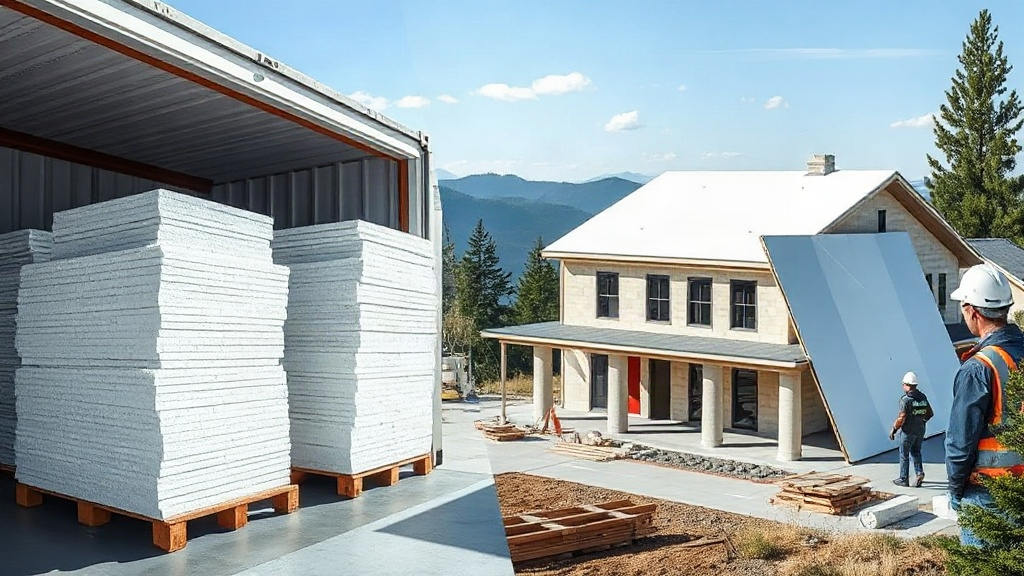
If you're planning a building project in Canada, you've likely encountered the debate between eps insulation and sandwich panels. Both are popular, but they serve different purposes. Understanding their strengths and limitations will save you time, money, and headaches. This article cuts through the marketing fluff and gives you practical insights to make an informed decision.
We'll explore what each option is, how they perform in Canadian climates, and when to choose one over the other. By the end, you'll know exactly which solution fits your project.
What Is EPS Insulation?
EPS, or expanded polystyrene, is a rigid foam insulation made from polystyrene beads expanded with steam. It's lightweight, affordable, and widely used in residential and commercial construction. You'll find it in walls, roofs, and foundations.
The key advantage of eps insulation is its versatility. It comes in various densities and thicknesses, allowing you to tailor the R-value to your needs. For example, a 1-inch thick EPS board typically provides around R-4, so a 4-inch board gives you about R-16. That's plenty for many applications, especially when combined with other insulation materials.
But EPS isn't just about thermal performance. It's also moisture-resistant, which is crucial in Canada's wet and cold climate. Unlike some other insulations, EPS doesn't absorb water, so it maintains its R-value even when exposed to moisture. That said, it's not a structural material on its own. You'll need a framing system to support it.
What Are Sandwich Panels?
Sandwich panels, also known as insulated metal panels (IMPs) or structural insulated panels (SIPs), consist of two rigid facings (often metal, wood, or cement board) bonded to a insulating core. The core can be EPS, polyurethane, or other foams. These panels are prefabricated and arrive on site ready to install.
The beauty of sandwich panels is their structural integrity. They can span between supports, carry loads, and serve as both the insulation and the finished surface. In many cases, you don't need additional framing or sheathing. This speeds up construction and reduces labor costs.
For Canadian projects, sandwich panels canada suppliers offer panels designed to meet local building codes, including high R-values and fire ratings. They're commonly used in cold storage facilities, warehouses, and even residential homes.
Comparing Performance in Canadian Climates
Canada's climate is harsh. From the freezing temperatures of the prairies to the wet, coastal conditions of British Columbia, your insulation must perform reliably. Let's compare EPS and sandwich panels on key metrics.
Thermal Resistance (R-Value)
EPS insulation has an R-value of about 4 per inch. Sandwich panels with an EPS core have similar R-values per inch of core thickness, but because they often come in thicker profiles (e.g., 4 to 8 inches), they can achieve higher overall R-values. For instance, a 6-inch sandwich panel with an EPS core might provide R-24, while a 6-inch EPS board alone would only give R-24 if you stack multiple layers, but you'd still need a structural system.
However, sandwich panels with polyurethane or polyisocyanurate cores can reach R-6 to R-7 per inch, outperforming EPS. But EPS remains a cost-effective choice for many applications.
Moisture Management
Both EPS and sandwich panels resist moisture, but sandwich panels have an edge because their facings act as a vapor barrier. In a Canadian winter, preventing condensation within the building envelope is critical. With EPS, you need to add a separate vapor barrier and ensure proper detailing to avoid moisture issues.
Air Tightness
Sandwich panels are inherently airtight due to their continuous facings and sealed joints. EPS insulation requires careful installation to achieve air tightness, often needing additional tapes or membranes. In a blower door test, a building with sandwich panels will typically score better than one with EPS alone.
Installation and Labor Considerations
Time is money in construction. Sandwich panels are prefabricated, so installation is fast. A small crew can erect a building envelope in days, not weeks. This reduces labor costs and accelerates project timelines.
EPS insulation, on the other hand, is installed piece by piece. It requires a framing system, sheathing, and separate weather barrier. The process is more labor-intensive and dependent on favorable weather conditions. If you're building in a remote area or during winter, sandwich panels might be the more practical choice.
But EPS offers flexibility. You can cut it on site to fit irregular shapes, making it ideal for renovations or complex architectural designs. Sandwich panels are less forgiving; they come in fixed dimensions and modifying them can compromise their integrity.
Cost Analysis: Upfront vs. Long-Term
On a pure material cost basis, EPS insulation is cheaper per square foot than sandwich panels. However, when you factor in the additional framing, labor, and time, the total installed cost of an EPS system can approach that of sandwich panels.
Sandwich panels have a higher upfront cost but may save you money in the long run through lower labor costs and better energy efficiency. For example, a warehouse built with sandwich panels might see 20-30% faster construction and lower heating bills due to superior air tightness.
It's essential to run a life-cycle cost analysis for your specific project. Consider energy savings, maintenance, and durability over 30 years.
When to Choose EPS Insulation
EPS insulation is a solid choice for:
- Residential retrofits where you need to add insulation without major structural changes.
- Projects with complex shapes or where custom fitting is required.
- Budget-conscious builds where upfront cost is the primary concern.
- Applications where you already have a structural system in place (e.g., wood or steel framing).
If you're insulating a basement, crawlspace, or exterior walls, EPS is often the go-to material. It's also great for insulated roof panels when combined with proper roofing membranes.
When to Choose Sandwich Panels
Sandwich panels shine in:
- Commercial and industrial buildings where speed of construction is critical.
- Cold storage facilities that require high R-values and airtight envelopes.
- Projects where a finished interior and exterior surface is desired without additional cladding.
- Areas with stringent energy codes, as sandwich panels can easily meet high performance targets.
For insulated roof panels, sandwich panels are particularly advantageous because they provide a seamless, weather-tight roof deck that insulates and protects in one go.
Making the Decision: A Practical Guide
Start by defining your project goals. Are you building a new structure or renovating? What's your budget? What are the energy code requirements in your province?
Next, consult with professionals. An experienced contractor or building envelope engineer can help you weigh the options. They'll consider factors like climate zone, building occupancy, and maintenance expectations.
Finally, think long-term. While EPS might save you money today, sandwich panels could offer better performance and durability over the life of the building. In Canada, where energy costs are rising, investing in a high-performance envelope often pays off.
Frequently Asked Questions
Can I use EPS insulation in a roof application?
Yes, EPS insulation is commonly used in roofs, but it must be covered with a weatherproof membrane and possibly a structural deck. For exposed roofs, insulated roof panels with a sandwich construction are often a better choice because they combine insulation and weather protection in one product.
Are sandwich panels suitable for residential homes in Canada?
Absolutely. Many Canadian homeowners use sandwich panels for walls and roofs, especially in modern, energy-efficient designs. They offer excellent insulation and can be finished with various interior and exterior materials. However, they may require a design professional to ensure they meet local building codes.
How do EPS insulation and sandwich panels compare in fire performance?
EPS insulation can be treated with flame retardants to meet fire safety standards, but it still burns and releases toxic smoke. Sandwich panels with mineral wool or polyisocyanurate cores offer better fire resistance. Always check the fire rating of the specific product and ensure it complies with the National Building Code of Canada.
What is the typical R-value of sandwich panels available in Canada?
Sandwich panels in Canada typically range from R-12 to R-40, depending on core material and thickness. EPS-cored panels generally provide R-4 per inch, while polyurethane cores can achieve R-6 per inch or more. For high-performance buildings, choose panels with higher R-values.
Can I install sandwich panels myself?
While it's possible for a skilled DIYer to install sandwich panels, it's not recommended for large projects. Proper installation requires specialized tools and knowledge to ensure airtightness and structural integrity. Mistakes can lead to moisture problems and reduced performance. Hiring a professional is usually the best approach.
Choosing between eps insulation and sandwich panels doesn't have to be overwhelming. By understanding your project's needs and the unique benefits of each option, you can make a decision that delivers comfort, efficiency, and value for years to come.